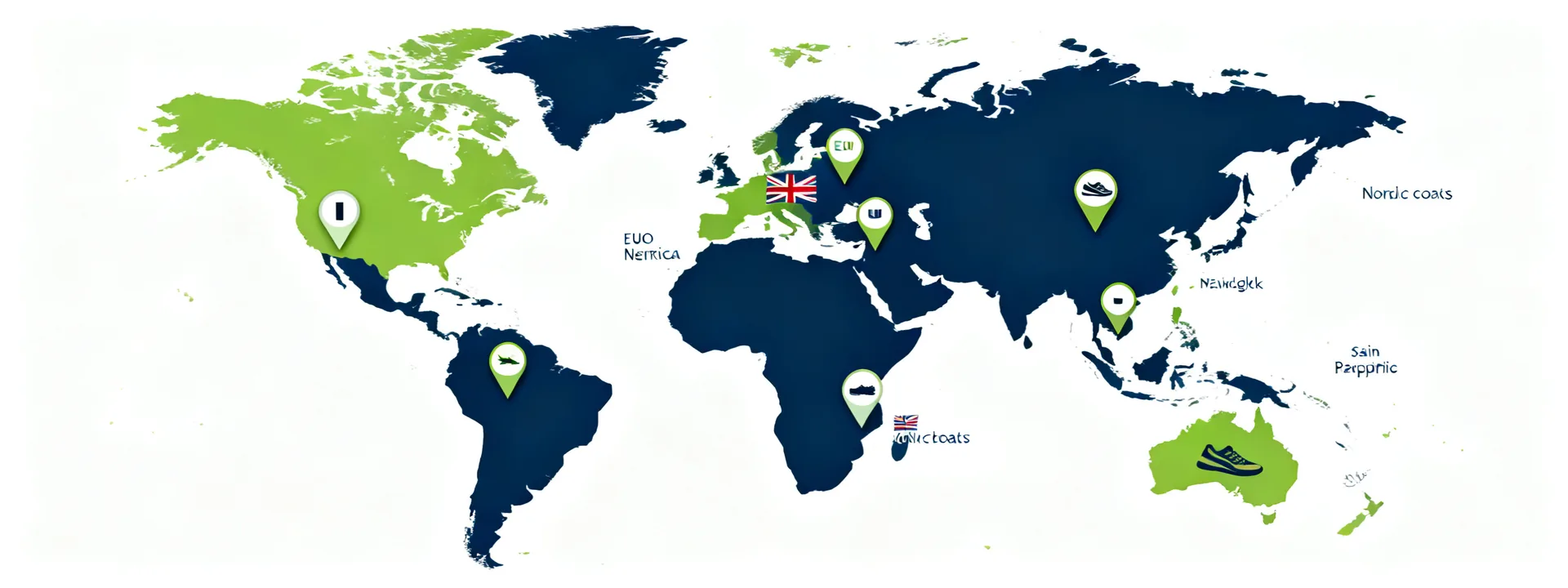
Helly Hansen hiking and sailing footwear across buyer channels
Assortment is planned by region and wear environment: hiking, sailing deck, trail, rain-commute and kids. Hiking-adjacent deck use is limited to marina parking lots, not alpine talus.
Tab by region, then match the wear environment
Helly Hansen does not sell one “outdoor shoe” to every climate. North American sporting-goods walls want a hiking boot with a stated hydrostatic class next to a lighter trail shoe. Nordic and coastal doors ask first about siped non-marking sailing shoes. EU retailers more often request OEKO-TEX STANDARD 100 by article. The tabs below are planning notes, not audited market-share claims.
United States and Canada retail, trail and team
US club and campus orders often mix hiking boots with trail running shoes and a shallow sailing-shoe run for coastal campus shops. Those sailing colorways still sit on a deck last, not on the hiking last. Kids lots need CPSIA tracking labels. Water-resistant trail shoes remain the summer core for park retailers. Family sporting-goods doors typically want a hiking boot plus a trail SKU, not a full yacht-deck wall.
GORE-TEX membrane boots are the Helly Hansen answer only when the tech pack names a bootie and a hydrostatic class. When a buyer asks for a waterproof-breathable hiker, the honest split is: membrane hikers with taped seams, PU-coated uppers with a lower hydrostatic head, or DWR-only trail shoes that drain splash. Mixing those three constructions in one planogram caption creates returns. Stock-wholesale replenishment stays on the one-business-day quote clock; private-label OEM colorways move to the five-business-day proposal.
EU and UK chemical and kids screens
European retailers more often request OEKO-TEX STANDARD 100 by article and BLUESIGN chemistry screens on dyes. Kids styles that fall under toy-adjacent definitions are screened to EN 71 where applicable. Hiking buyers want named hydrostatic class rather than a generic rain icon. Packing files should leave space for language-specific hangtags. REACH-related additive questions are answered from the mill dossier, not from a marketing sentence. PU coating versus a GORE-TEX bootie is a frequent EU brief; the desk will not print a membrane claim on a coated upper.
Nordic and coastal sailing plus wet hiking
Sailing shoes with siped non-marking rubber lead marina and club doors. Hiking boots with an 8–12 mm drop and a lugged rubber or Vibram outsole sit beside them for trail days off the boat. The two outsoles do not share a tool. Salt-fog notes stay on the sailing construction sheet. A hiking lug that marks gelcoat is treated as a mis-ship, not as a dual-use feature. Wet hiking still uses the membrane class; cockpit work uses drainage and siping.
Asia-Pacific trail and e-commerce size runs
Trail running shoes and rain-commute hikers lead the warm-weather calendar. E-commerce partners need a wider size run than a single specialty door. OEM colorway requests from regional brands follow the existing-last sampling window of 12–18 working days. Soccer-inspired colorways for fan retail are decoration projects on existing lasts unless a new last is funded. Import documentation is quoted per destination; it is not bundled into the one-day stock clock.
Channel mix the partner desk actually plans
Bars are internal planning shares for athletic outdoor footwear programs, not audited market-share claims.
Hiking and sailing remain the two cores. Trail foam and rain-commute DWR sit as overlays. Soccer and basketball color stories are treated as decoration unless a funded last exists. EVA versus Phylon is chosen after activity is named, not as a site-wide slogan.
Map your channel assortment with Helly Hansen
Tell us region, wear environment and whether the order is stock, colorway or full OEM. The desk will not flatten those three into one ship date.
- Hiking and deck lasts with named-lab files
- Kids CPSIA / EN 71 screening when the article requires it
- Trail foam kept separate from hiking geometry